Obby: Disaster Survival
- 3.3
- Rating
- 1.00M
- Installs
- Free
- Price
 Analysis by App-foxy
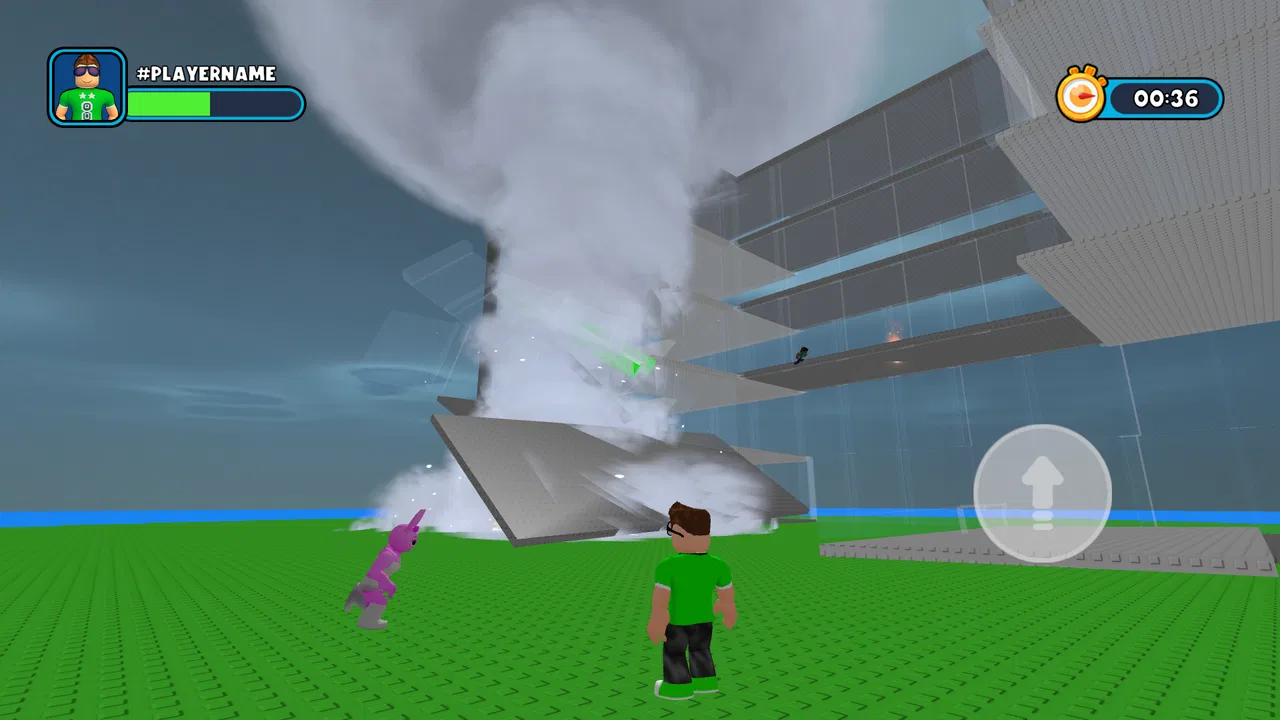
Obby: Disaster Survival is an adventure game from Blox Global built around a simple question: can I keep moving when the course itself is trying to throw me off? I found the appeal easy to understand. It takes the familiar obstacle-course idea and places it inside a survival-minded setting, where timing, patience, and a willingness to retry matter more than complicated controls.
That simplicity is also the first thing to understand before downloading it. This is not a story-heavy adventure with a large cast, deep exploration, or a long list of systems to master. It is a focused obstacle challenge, best suited to short sessions and players who enjoy learning through mistakes. I would recommend it to someone who likes platforming pressure and quick attempts, but I would not choose it for a player looking for a rich narrative or a broad world to explore.
What the game feels like in everyday play
My first impression was that the game asks for attention immediately. An obstacle course can look easy when viewed from a distance, yet the real test comes from judging movement while the surroundings create a sense of danger. That makes each section feel less like a relaxed walk and more like a small decision-making exercise: move now, wait for a safer opening, or risk a shortcut and possibly start again.
You May Also Like

 Blood Strike: 2.5 Anniversary
Blood Strike’s Loadouts Turn Every Drop Into a Tactical Gamble
A close look at Blood Strike’s custom loadouts: how fast access to signature weapons reshapes its battle royale rhythm, rewards preparation, and narrows the gap between fights.

 Pandora - Music & Podcasts
Pandora’s Music Is Easy to Start, but Harder to Recover
Pandora’s strength is its low-effort path from a seed to a station. Its weak spot is how much confidence it asks you to place in connection, setup, and quiet recovery.

 8 Ball Pool
 Is Built on Rivalries, Rematches, and Routine
A close look at the rivalries, rematches, shared routines, and unanswered safety questions that turn a quick pool match into a persistent mobile community.

 Samsung Music
’s Quiet Strength Is Playing What You Already Own
Its reach comes less from spectacle than from dependable access to a personal library. That simplicity is both the app’s strongest retention engine and its ceiling.

 AccuWeather: Weather Radar
AccuWeather Review: A Quick, Clear Forecast for Everyday Decisions
For everyday plans, the best forecast is the one you can understand quickly. AccuWeather makes rain timing, radar, and local conditions easy to act on, with a few trade-offs.

 Hill Climb Racing
Why Hill Climb Racing Still Turns Crashes Into One More Run
A tiny car, a bumpy hill and one more upgrade: Hill Climb Racing keeps resurfacing because its simple chaos makes every near-miss feel personal.
More From Our News Desk
View All News


The adventure category fits because the central experience is about navigating hazards rather than simply collecting items or fighting opponents. The store summary frames the game around surviving an obby, and that description is more useful than it may seem. It tells me to expect movement-based challenges first. If you enjoy jumping, positioning, and repeating a difficult route until your hands remember it, the design should feel familiar.
I also appreciate that the game is free to download. That makes it easy to test during a spare moment without committing money at the outset. Still, free access should not automatically be interpreted as unlimited value. The real question is whether the obstacle format remains enjoyable after the novelty fades, and whether any spending pressure changes the experience. Those are the points I would consider before treating it as a regular game rather than a quick experiment.
The age classification is Everyone, which makes the game broadly approachable for families and younger players. That label does not guarantee that every child will enjoy the repeated failure involved in obstacle courses, though. A younger player may need encouragement when a section demands several attempts, while an older player may enjoy the same frustration as a test of patience. I would introduce it as a game about practice, not as something that should be completed instantly.
Controls reward patience more than speed
Obstacle games often tempt players to rush because a fast attempt feels exciting. In my experience, that is usually the wrong instinct here. A better approach is to observe the route, identify the safest landing points, and then make one deliberate movement at a time. The useful skill is not just quick reaction; it is recognizing when not to move.
One practical habit is to treat every failed attempt as a short lesson. If I miss because I moved too early, I change the timing rather than randomly trying again. If I land safely but lose control immediately afterward, I slow down before the next jump. This sounds obvious, but it turns repetition into progress instead of making the game feel like an endless loop of luck.
Another helpful technique is to use short play sessions. A difficult course can become harder when I keep playing while annoyed, because frustration encourages rushed inputs. I would rather attempt a section for a few minutes, pause, and return with a clearer view of the timing. That approach is especially useful for children, who may interpret repeated failure as unfair when the real issue is fatigue or impatience.
Progress can feel rewarding, but pressure is part of the design
The strongest emotional moment in this kind of game is not reaching the end of an entire course. It is finally passing the one obstacle that repeatedly stopped me. That small victory gives the game its rhythm: observe, fail, adjust, and try again. Players who enjoy visible improvement from repetition will probably get more from it than players who want constant new content.
The trade-off is that progress may feel narrow if you do not enjoy the obstacle format itself. A player can spend a session improving movement without receiving the broader rewards found in adventure games with quests, character development, or exploration. I would therefore judge the game by the quality of its moment-to-moment challenge, not by expecting a large progression system.
For a realistic everyday scenario, imagine having ten minutes while waiting for an appointment. This is the kind of game I would open for that gap: the central idea is immediately understandable, and an attempt can be short. I would not start it when I wanted a calm game before sleep, however, because repeated misses can create more tension than relaxation. It is better for focused breaks than for quiet background play.
There is also a useful distinction between personal progress and visible completion. Finishing a section may feel satisfying, but the more important improvement is learning how the route behaves. Once I stop treating every obstacle as a surprise and begin anticipating the timing, the game becomes less about reflex panic and more about controlled movement. That shift is where the experience becomes genuinely engaging.
Fairness, spending, and what I would check before committing
The game is listed as free, which removes the biggest barrier to trying it. However, I would not make claims about optional purchases, boosts, advertisements, or paid advantages without seeing them directly in the current version. The sensible purchase context is therefore simple: download it at no cost, play enough to decide whether the core obstacle challenge suits you, and avoid assuming that free access tells the whole story about the economy.
For me, fairness means that success should mainly reflect timing, route knowledge, and persistence rather than a player’s willingness to spend. That is the standard I would apply while playing. If a paid option appears, I would ask whether it changes the challenge, shortens repetition, or merely provides a cosmetic convenience. A purchase that changes appearance is very different from one that makes difficult sections substantially easier.
This matters particularly in a survival-themed obstacle game. The tension comes from believing that a careful attempt can succeed. If spending can bypass the central test, the achievement may feel less meaningful. On the other hand, a player who only wants to experiment with routes may welcome convenience. My advice is to decide what kind of satisfaction you want before paying: mastery, speed, customization, or simply access to more play.
I would also be careful with younger players. Because the game is suitable for Everyone and costs nothing to start, it may look like a low-risk download. A parent should still explain that free games can present optional spending and that asking before purchasing is important. That is not a criticism of this particular title; it is a practical rule for any game that invites repeated play.
Does the challenge feel competitive?
The competitive side depends on what the game places in front of the player. Even without treating it as a formal contest, obstacle courses naturally create comparisons: who reached a section first, who stayed calm, and who completed a route with fewer mistakes. I prefer to use those comparisons as motivation rather than as proof that one player is better in every way.
Fair competition requires consistent movement and understandable hazards. When I fail, I want the reason to be visible afterward. A missed jump should teach me something about timing or positioning, not leave me wondering whether the outcome was random. That clarity is especially important for new players, because unexplained failure can make a course feel unfair before they have learned its rhythm.
Compared with a conventional adventure game, this experience offers less variety in how I solve problems. In a story-driven title, I might explore, talk to characters, manage equipment, or choose between several routes. Here, the main answer is usually better movement. That narrower focus can make the game feel fairer because the goal is clear, but it can also make mistakes feel repetitive when a particular section has to be replayed often.
Compared with a standard casual platformer, the disaster-survival framing adds urgency. The difference is not necessarily a deeper system; it is the mood created by treating the course as something to endure. I found that framing useful when I wanted a quick challenge, though players who prefer peaceful platforming may find the pressure unnecessary.
Who should play, and who should skip it?
I think the best audience is someone who enjoys obstacle courses, short attempts, and the satisfaction of improving through repetition. It also suits players who want a free adventure game that can be understood without a long tutorial. Families may appreciate the accessible premise, provided younger players are comfortable with failure and have clear limits around optional spending.
I would skip it if your priority is a substantial story, character progression, strategic combat, or open-ended exploration. I would also hesitate to recommend it to anyone who dislikes replaying the same challenge. The game’s appeal depends heavily on the belief that another attempt can be better than the last. If repetition feels like wasted time to you, the central loop may become tiring quickly.
Players with limited patience should try it in small portions rather than judging it after an irritated session. Conversely, experienced platforming fans may want to approach it with restraint instead of assuming that speed will carry them through. The most reliable improvement comes from learning the route and controlling momentum, not from forcing every jump as quickly as possible.
Version, reach, and practical expectations
The current version is 1.10, and the game requires Android 7.0 or later. That makes compatibility straightforward for many Android users, but I would still check the operating system on an older phone before planning to play. A compatible device is only the starting point; comfort also depends on how easily you can read the course and control movement on your screen.
Blox Global has reached over a million installs, so this is not an obscure experiment with no audience. The average rating sits at 3.4 from around one thousand ratings, a mixed result that I would interpret carefully. It suggests that the game has found players, while also indicating that the experience will not satisfy everyone. For an obstacle game, that split makes sense: players who enjoy repetition may find the challenge compelling, while others may see the same loop as frustrating.
The listing shows eleven reviews, which is a relatively small written sample compared with the broader rating count. I would therefore give more weight to my own short trial than to any single comment. Ratings can reveal that opinions vary, but they cannot tell me whether a specific obstacle style, control feel, or spending choice will match my preferences.
Small habits that make the experience better
My first tip is to separate route learning from speed attempts. On an early run, I would focus on discovering where the danger changes and where a safe pause is possible. Only after understanding those points would I attempt a faster route. This prevents a common mistake: repeatedly failing because I am trying to optimize a path I have not actually learned.
My second tip is to use a reset in attitude after a cheap-looking mistake. Calling a failure “random” can hide a useful clue. Was the approach too close to an edge? Did I jump while still turning? Did I continue moving after landing? Naming the error gives the next attempt a purpose. That is a more reliable workflow than changing several actions at once.
My third tip is to stop before frustration changes the way I play. In a game built around timing, tired hands and impatience can look like bad level design. A brief pause can reveal whether the section is truly difficult or whether I am simply repeating the same rushed input. This is also the best way to keep the game suitable for a short, enjoyable break rather than turning it into an unwanted argument with the screen.
A final trade-off is choosing between personal mastery and social comparison. If other players’ progress motivates you, comparison can add energy. If it makes every mistake feel embarrassing, ignore the race and treat the course as a personal practice space. The game is more enjoyable when the pressure supports improvement instead of replacing it.
My trust verdict
After looking at the game as both a player and a potential recommendation, I see a clear but limited proposition. It offers a free way to try an adventure-style obstacle challenge from Blox Global, with an Everyone age rating and broad Android compatibility from version 7.0 onward. Its audience size shows that plenty of people have tried it, while the mixed average rating tells me to keep expectations measured.
The fairest way to approach it is as a focused skill game, not as a complete adventure world. That expectation makes its strengths easier to appreciate. The game can provide a satisfying burst of concentration, especially when a difficult section finally becomes manageable. It can also teach patience, route reading, and controlled movement in a way that a simple casual game may not.
My reservations are equally clear. The narrow obstacle-course loop will not replace a story-rich adventure, and repeated attempts can become frustrating for players who want steady variety. I would also make any spending decision only after understanding exactly what an optional purchase changes, rather than assuming that a free download guarantees a completely pressure-free experience.
In the end, I would recommend Obby: Disaster Survival to a friend who enjoys platforming challenges and wants something free to test in short sessions. I would tell a story-focused player to choose a different adventure game, and I would warn an impatient player that failure is not a side effect here; it is part of the route to improvement. If that sounds enjoyable rather than irritating, this compact survival obby is worth trying.
For me, the deciding question is not whether every player will survive the course. It is whether you enjoy learning why you failed and making the next attempt more deliberate. If the answer is yes, the game has a straightforward reason to stay installed. If the answer is no, its free entry point is still useful: you can discover that quickly without paying first.
FAQs for Obby: Disaster Survival
01What is Obby: Disaster Survival all about?
Obby: Disaster Survival is a thrilling adventure game where players must navigate through various natural disasters, such as earthquakes, floods, and tornadoes. The objective is to survive each disaster by using strategy, quick thinking, and teamwork. With its challenging levels and engaging gameplay, it offers hours of entertainment for players of all ages.
02Is Obby: Disaster Survival suitable for children?
Yes, Obby: Disaster Survival is designed to be family-friendly and suitable for children. The game features animated graphics and simple controls that are easy for younger players to understand. However, parental guidance is recommended to ensure that the disaster scenarios are not too intense for sensitive children.
03Does Obby: Disaster Survival require an internet connection?
Obby: Disaster Survival can be played offline, which is great for users who do not have constant access to the internet. However, an internet connection is required for certain features, such as multiplayer modes and accessing updates. This allows players to enjoy the game anywhere, anytime.
04Are there in-app purchases in Obby: Disaster Survival?
Yes, Obby: Disaster Survival includes in-app purchases. Players can buy items such as skins, boosts, and additional levels to enhance their gaming experience. While these purchases can enhance gameplay, they are optional, and the core game is fully playable without spending any money.
05How challenging is Obby: Disaster Survival for new players?
Obby: Disaster Survival offers a range of difficulty levels, making it accessible for beginners while still challenging experienced players. The game starts with easier levels to help new players get accustomed to the controls and gameplay mechanics. As players progress, the challenges become more complex, providing a rewarding experience for all skill levels.
Pros
- Engaging multiplayer experience
- Variety of disaster scenarios
- Intuitive controls
- Regular updates with new content
- Great community support
Cons
- Occasional connectivity issues
- Some scenarios feel repetitive
- In-app purchases can be pricey
- Ads can be intrusive at times
- Limited offline functionality

Obby: Disaster Survival
Gallery